REF. GR-2026 / SKIN STRUCTURE
Not the treatment in fashion —
the treatment you need, performed by specialists
We never recommend without a diagnosis, and we explain the limitations too. From consultation to procedure, everything is performed directly by board-certified dermatologists.
Epidermis 0.1 mm, Dermis 1–3 mm, Fat layer 3–8 mm, SMAS approx. 4.5 mm
Depths are given as ranges because they vary by area and individual. Pending clinical review.Background video is a concept illustration, not the actual clinic interior or a treatment result.
Why Grays
How Grays approaches care
Instead of glossy promises, we state only facts you can verify before you visit.
Specialist-performed care
Consultation, diagnosis and procedures are all performed directly by board-certified dermatologists.
Private VIP rooms
Consultations and procedures take place in fully private, single-patient rooms.
Authentic devices · 25 systems
Genuine, authenticated equipment and metered dosing — 25 in-house systems matched to layer-by-layer diagnosis.
Functional-medicine dermatology
For atopic and chronic skin conditions we add functional-medicine testing to address the cause.
Plate — Blueprint & Tissue
Reading skin as architecture
The same four layers, cut in two: building materials on the left, actual skin tissue on the right. It is why the way we reinforce depends on which layer has weakened.
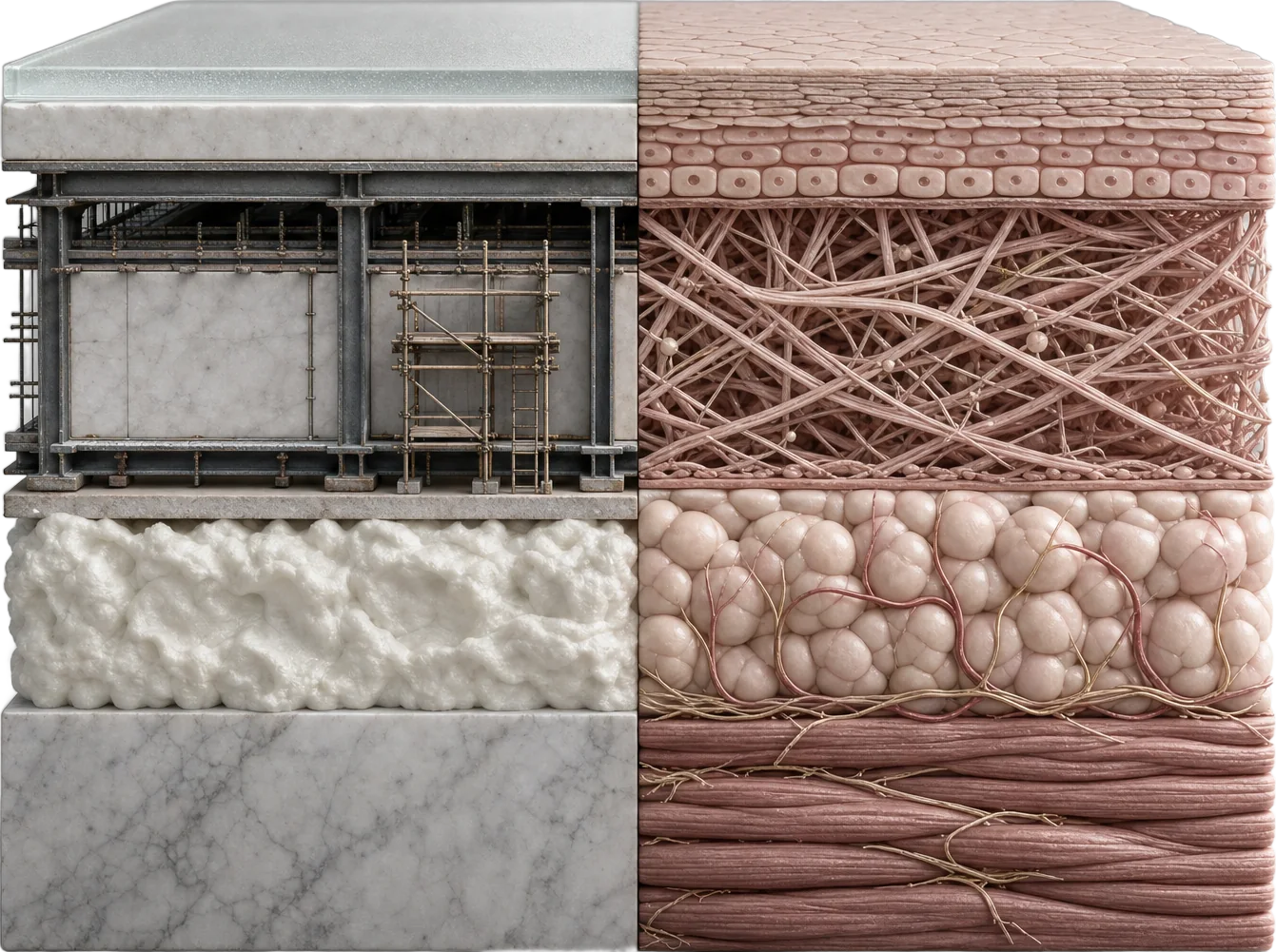
Architectural model
- Surface finishGlass and porcelain finish
- Load-bearing wallSteel beams, rebar and marble panels
- Load distributionSoft, pliable fill
- FoundationSolid marble foundation
Skin tissue
- EpidermisStacked epithelial cells and a translucent horny layer
- DermisCollagen and elastin framework with fibroblasts
- Fat layerSubcutaneousFat lobules threaded with blood vessels
- SMASDense fibrous and muscular base
Section 01 — Survey
Skin is a structure, not a surface
Two people with similar sagging may need different treatments, because the weakened layer differs. At Grays we identify the layer before selecting a device.
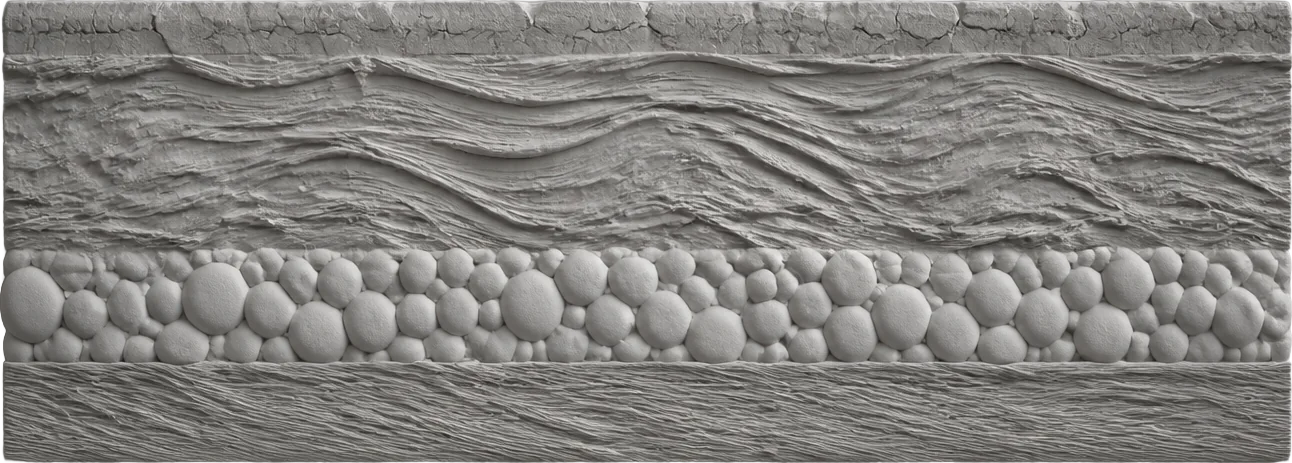
- Epidermis / 0.1 mm
EpidermisSurface finish
Pigmentation and rough texture
- Dermis / 1–3 mm
DermisLoad-bearing wall
Loss of firmness as collagen declines; pores and scars
- SMAS / approx. 4.5 mm
SMASFoundation
Sagging as structural support weakens
This diagram is simplified for explanation. Your actual assessment is made during consultation.
Concerns
Find treatments by concern
You don't need to know device names. Choose a concern and we'll guide you to the right options.
Lifting & Firming
L4Lifting & Firming
“Lift, naturally”
Ultherapy PRIME · Thermage · Tune Face +
Volume & Contour
L3Volume & Contour
“Restore balance, refine contour”
Juvelook / Juvelook Volume · Botulinum Toxin (Botox) · HA Filler +
Skin Boosters
L2Skin Boosters & Regenerative Injections
“Replenish from within”
Juvelook / Juvelook Volume · Rejuran / Rejuran HB · SkinVive +
Pigmentation
L1Melasma, Sun Spots & Pigmentation
“Brighten, gently”
PicoWay / PicoWay Resolve · StarWalker MaQX · GentleMax Pro +
Acne
L2Acne & Acne Marks
“Calm the flare”
Potenza · Smoothbeam · LaLa Peel +
Redness & Vessels
L2Redness & Visible Vessels
“Settle the redness”
GentleMax Pro · Potenza · Vbeam Perfecta
Pores & Scars
L2Pores, Scars & Skin Texture
“Smooth and refine”
Ultherapy PRIME · Tune Face · Oligio +
Hair Removal & Tattoo Removal
Laser Hair Removal & Tattoo Removal
“Clear it away, cleanly”
PicoWay / PicoWay Resolve · StarWalker MaQX · GentleMax Pro
Medical Dermatology
Medical Dermatology (Insurance-Covered Care)
“Treat the discomfort”
Nail Fungus (Onychomycosis) Treatment · Body Botox
Skin Care & Recovery
L1Skin Care & Recovery
“Protect and strengthen”
Revive Exosome · IV Nutrient Drip
Section 02 — Sequence
Order matters, and it means less treatment
Finishing a surface before the foundation is sound means doing the work twice. Treatment follows the same logic.
- PH.01
Survey
We identify the layer first. No treatment is recommended at this stage.
- PH.02
Foundation
We start with the supporting layers — SMAS and fat.
- PH.03
Structure
We rebuild dermal collagen to restore firmness.
- PH.04
Finish
We even out pigment and texture at the surface.
Before & After
Documented under identical conditions
Photographed with the same lighting and angle, never retouched.
- Ultherapy lifting, 3-month follow-up
Ultherapy lifting, 3-month follow-up
- Thermage firmness improvement over time
Thermage firmness improvement over time
- InMode double-chin progress over sessions
InMode double-chin progress over sessions
- PicoWay sun spot removal progress
PicoWay sun spot removal progress
Before-and-after photos are published with the patient's written consent, taken under identical conditions (lighting, angle) and never retouched. Results vary by individual.
View all before & after →Sagging or loss of firmness?
We first diagnose which layer is sagging (SMAS, dermis, fat) — then choose the device.
Start planning →Melasma or dark spots?
Lesion differentiation comes first. Melasma is managed and controlled, not erased.
Start planning →Scars or enlarged pores?
We map your scar types, then design a combination treatment for each type.
Start planning →
Doctors
Two board-certified dermatologists, one team
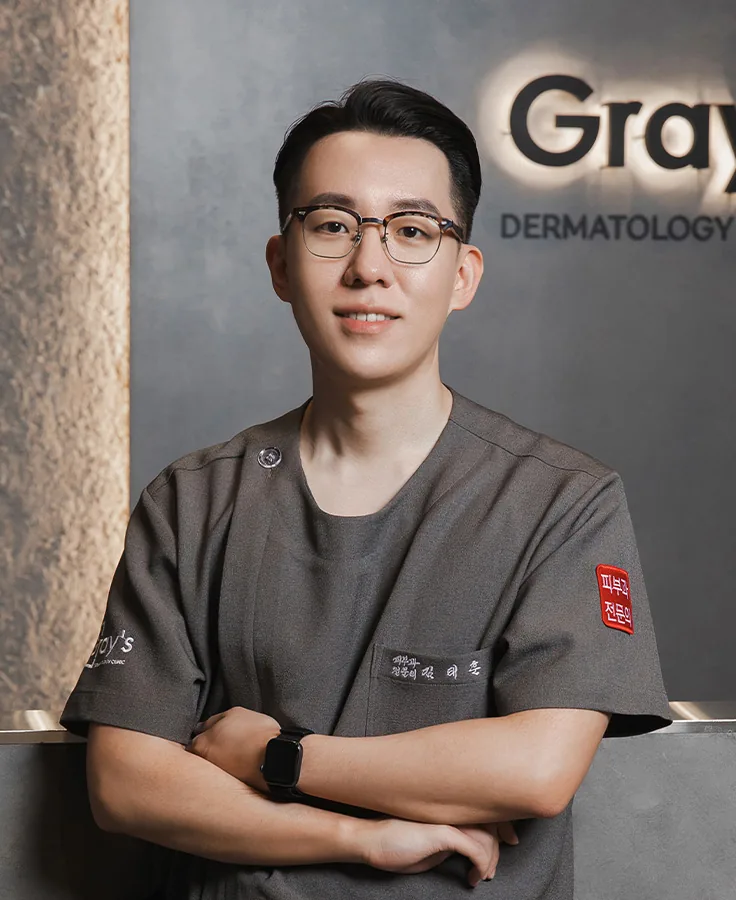
Dr. Kim Tae-hoon
Medical Director · Board-certified Dermatologist
Skin should be diagnosed as one system, not one spot. Only on an accurate diagnosis do we propose what is needed — and only as much as needed.

Dr. Kim Jung-hwan
Board-certified Dermatologist
Half of a good procedure is an honest explanation. We decide together, after explaining limitations and recovery in full.
Verify Before You Visit
We don't ask for your trust. We make it verifiable.
Specialist credentials in the academic society database, non-covered fees in the published price list, reviews on independent platforms — every verification path is public, so you can check before you visit.
Verify our credentialsLocation
Getting here
10F L Tower, 6 Jwadong sunhwan-ro, Haeundae-gu, Busan, Korea
Near Jungdong Station (Busan Metro Line 2) — walking directions from the exit to L Tower 10F (video coming soon)
Tower parking at L Tower and nearby public lots available (validation policy pending review)
- Weekdays
- 10:00 – 19:00
- Saturday
- 10:00 – 14:00
- Sunday & holidays
- Closed
Guides & Columns
Reading that helps you decide
Before recommending a treatment, we believe in giving you the criteria to judge for yourself.
Guide
Ultherapy vs. Thermage: Which One Fits My Sagging?
The short answer: if sagging of the SMAS layer is your main concern, Ultherapy comes first; if dermal laxity and fine lines are the main concern, Thermage comes first. The two are not competitors — they act on different layers — and when sagging and laxity coexist, they are sometimes combined.
Guide
Juvelook vs. Rejuran vs. SkinVive — Choosing by Goal
The right question is not 'which booster is better' but 'what is my skin missing.' If the goal is collagen production and texture, consider Juvelook first; if it is restoring regenerative capacity, Rejuran; if it is inner dryness and glow, SkinVive.
Guide
Melasma, Sun Spots, and Lentigines: Telling Them Apart and Choosing a Laser
Though they may look similar, melasma, sun spots (seborrheic keratoses), lentigines, and nevus of Ota are distinct diagnoses that differ in depth and character. Identifying the lesion comes first and choosing the laser second — and above all, melasma is not a lesion to blast away but one to lighten and manage over time. That principle is the starting point of any treatment plan.
Guide
Acne Scar Treatment Combinations by Scar Type
Because depressed scars are almost never one type — most faces carry a mix of rolling, boxcar, and ice-pick scars, and each type responds to a different treatment. Improvement widens only when subcision (to release tethering), TCA cross (for narrow, deep scars), and resurfacing lasers are combined according to a map of your scars.
FAQ
Frequently asked questions
Clinic information
Where is Grays Dermatology located in Busan? Is parking available?
Grays Dermatology is located on the 10th floor of L Tower, 6 Jwadong-sunhwan-ro, Haeundae-gu, Busan, and is staffed entirely by board-certified dermatologists. The clinic is directly in front of Exit 8 of Jungdong Station on Busan Metro Line 2.
It is easily reached from Marine City and Centum City, and it is close to Haeundae Beach, Mipo, Songjeong and Osiria in Gijang, so visitors travelling in eastern Busan or staying at nearby hotels can come in easily. The Haeundae intercity bus terminal is also nearby, which makes public transport from outside Busan convenient.
If you come by car, you may use the tower parking facility inside the L Tower building. If tower parking is not suitable for your vehicle, the nearby Jungdong Station public parking lot is available.
For details on parking or directions, please contact the clinic at +82-51-710-1891.
What are your opening hours? Are you open on Saturdays?
Yes. Grays Dermatology is open on Saturdays, and evening consultations are available until 8 p.m. on Tuesdays and Fridays.
Mon, Wed, Thu : 10:00 – 19:00
Tue, Fri : 10:00 – 20:00 (evening hours)
Saturday : 10:00 – 15:00 (open through lunch)
Weekday lunch break : 13:00 – 14:30
Sundays and public holidays : closed
Evening hours on Tuesday and Friday make it possible to visit after work, and Saturday runs without a lunch break for those who cannot come on weekdays. Hours and closures may change, so please check our website or call the clinic before visiting.
How do I make an appointment? Can I visit on the same day?
Same-day appointments and walk-in visits are both possible, but waiting times can be long depending on the schedule and the treatment you want, so we recommend booking in advance where possible.
You can book by phone (+82-51-710-1891), through our KakaoTalk channel or via Naver TalkTalk, and you are welcome to ask about same-day availability. International patients can book and adjust their schedule from overseas through WeChat, LINE or Google Reservations.
Lifting procedures such as Thermage FLX and Ulthera, and any treatment that requires anaesthetic preparation, need sufficient consultation and treatment time. Booking ahead shortens your wait and allows the session to run smoothly.
If you visit without an appointment we will try to see you, but same-day treatment may not be possible depending on the schedule and the procedure you choose.
Lifting treatments
What is the difference between Ulthera and Thermage? Which one is right for me?
Ulthera uses high-intensity focused ultrasound (HIFU) to concentrate energy at a chosen depth beneath the skin, focusing on lifting sagging tissue at deeper layers. Thermage FLX delivers monopolar radiofrequency (RF) energy broadly across the skin to induce collagen contraction and regeneration, focusing on elasticity and tightening. Put simply, Ulthera is closer to 'lifting at depth' and Thermage to 'overall skin tightening'.
In practice, however, what matters more than comparing which treatment is better is how the two energies should be applied to each individual. The degree of ageing, the thickness of the skin and subcutaneous fat, the direction and location of sagging, overall facial contour, and the change you most want to see all have to be considered together.
Two patients of the same age with similar sagging may need different approaches: one may benefit from a greater share of ultrasound lifting, while another may achieve a more natural result with RF tightening as the mainstay. In some cases combining the strengths of both is the most effective option.
At Gray's, a board-certified dermatologist examines your facial structure and pattern of ageing directly, then designs the role and proportion of Ulthera and Thermage individually. This difference in treatment design is what shows up in the result and in patient satisfaction.
What is 'Ulthermage'? Can I have both treatments together?
'Ulthermage' is the term commonly used for combined lifting in which Ulthera and Thermage are performed together.
Ulthera delivers focused ultrasound (HIFU) energy to a target depth beneath the skin, while Thermage delivers monopolar RF heat more broadly through the skin and subcutaneous tissue. Because their delivery methods and treatment goals differ, the two are complementary, and pairing them is one of the representative strategies for addressing several facial layers at once.
What matters, however, is not selecting the specific 'Ulthera + Thermage' pairing. It is judging which part of your face needs which energy at which depth, and then distributing the roles and energy of HIFU and monopolar RF accordingly.
This also means a limited budget does not force you to choose only one. Within the same budget, different HIFU and monopolar RF pairings can be considered according to your skin condition and the depth of treatment required — for example XERF + V-RO, Oligio + Ultherapy, or Oligio + V-RO. Where deeper lifting is needed, the share of HIFU is increased; where elasticity and tightening are needed, the share of monopolar RF is increased.
Ultimately, good lifting is not defined by a device name or a shot count. Rather than applying a fixed 'Ulthermage' package uniformly, we design the type of device, the treatment area and the energy distribution individually, taking into account skin thickness, subcutaneous fat, the location and direction of sagging, facial contour, the change you want and your budget.
What kind of treatment is Tune Face?
Tune Face uses the radiofrequency (RF) technology of the Accent Prime platform for purposes such as skin elasticity, tightening and improvement of facial contour. Accent Prime supports several handpieces based on RF and ultrasound technology, so rather than repeating an identical treatment with one device, the required energy and handpiece can be selected according to skin thickness, fat distribution, loss of elasticity, scarring and the area being treated.
For example, Tune Liner (MiniSpeed) can be used for contour improvement where a double chin or localised fat is a concern; UniLarge delivers RF energy over broader areas for elasticity and skin texture; and the Microplasma technology of Legato is used for acne scarring and irregular skin texture.
At Gray's we use Accent Prime on its own, in combination with other energy-based lifting such as Ulthera and Thermage, or as part of a pre-heating step that warms the required area sufficiently in advance. The point is not to apply a particular handpiece uniformly, but to assess skin thickness, fat distribution and the direction and degree of sagging, then distribute the appropriate energy to the required area and depth.
Injectables & boosters
How do skin boosters and collagen boosters differ from fillers?
Fillers use substances such as hyaluronic acid to create volume and structural support directly where it is needed. They are often more suitable beneath the retaining ligaments, where tissue needs to be held up, or in areas such as the nose and chin where a defined shape and contour is required.
Collagen boosters, rather than filling space, prompt the skin and soft tissue to form their own collagen. Instead of building up a specific point, they are used to improve broad areas of hollowing such as the cheeks and temples, along with loss of elasticity and density, in a more natural way.
Skin booster is a broader term still. Depending on the product and its ingredients, the goal may be regeneration, hydration, skin texture or elasticity. Rejuran, whose main aim is to improve the skin environment and its regenerative capacity, and Juvelook, which induces collagen production more actively, are both called skin boosters, yet their actual roles and purposes differ.
The question is therefore not which is better, but what needs to be improved. Where structural support and contour are needed, a filler; where natural volume across a broad area and collagen recovery are needed, a collagen booster; where skin texture, hydration and regeneration are the issue, a skin booster suited to that purpose — or a combination.
Rather than injecting large volumes of whatever ingredient is currently in fashion, we first determine what your skin lacks and which function needs to be restored, then combine ingredients with different roles so that hydration, regeneration and collagen formation support one another. Our aim is that your skin remains healthier than before treatment even after the direct effect of the injected material has faded.
What kind of treatment is Juvelook Volume?
Juvelook Volume is a collagen booster that uses PDLLA to induce collagen production in the skin and soft tissue, gradually restoring volume where it has been lost.
Unlike hyaluronic acid fillers, its main purpose is not to create immediate shape and volume through the injected material itself; instead it induces collagen formation over time, which makes it well suited to improving broad areas of hollowing such as the cheeks and temples naturally. Where a defined contour or structural support is required, as at the nose or chin, a filler may be more appropriate.
With PDLLA collagen boosters, how the product is prepared and hydrated before treatment matters as much as which product is used. Preparing the material so that the PDLLA particles are fully and evenly dispersed improves the uniformity of the treatment and reduces the possibility of side effects such as nodules, while supporting the intended tissue response and collagen formation.
For this reason we do not hydrate Juvelook hurriedly on the day and treat immediately, nor do we prepare product in bulk for multiple patients in advance. Once your appointment is confirmed, your name and the hydration start date are recorded separately and hydration of a vial for you personally is begun in advance. Product that has gone through a sufficient preparation period is used only for the patient it was booked for, and if that treatment does not take place it is discarded rather than used for anyone else.
Because sufficient hydration time must be secured, Juvelook Volume requires booking at least one week in advance. We believe that how the product was prepared and into which area and layer it was injected matters far more than 'how many vials were used'.
What is Ultracol, and can it be used under the eyes or on the forehead?
Ultracol is a collagen booster made from PDO (polydioxanone), long used in medical sutures, in the form of fine particles. As the injected PDO particles break down slowly in the body, they induce collagen formation in the surrounding tissue, improving skin elasticity and density, fine lines and hollowing in a natural way.
It can be used under the eyes and on the forehead. These areas call for a more precise approach because the skin is thin and the anatomy delicate, but with the right concentration and injection plane, Ultracol can be used to improve thinning skin and fine lines under the eyes, and loss of elasticity and subtle hollowing on the forehead.
Ultracol is not appropriate for every case of under-eye hollowing or forehead volume loss. Under the eyes, protrusion of orbital fat, the depth of the tear trough, ligament structure and midface volume loss all contribute alongside skin thickness, so depending on the cause a filler, a different collagen booster or a lifting treatment may be more suitable.
Ultracol is likewise never simply mixed immediately before treatment; as a matter of principle it goes through a sufficient hydration process. Once your appointment is confirmed, your name and the hydration start date are recorded and hydration of a vial for you personally is begun in advance. Prepared product is used only for that patient, and is discarded rather than used for anyone else if the treatment does not take place. Ultracol therefore requires booking at least five days in advance.
At Gray's we design the concentration, injection depth and volume of Ultracol individually, taking into account skin thickness, fat and skeletal structure, the location and depth of hollowing, and movement with facial expression.
Consultation
Tell us your concern — a board-certified dermatologist will answer with a treatment plan
You don't need to know which treatment you need. It starts with telling us what bothers you.